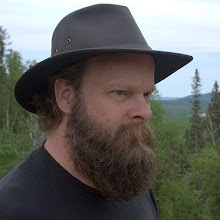
The Men's Resource Center - Bear Essentials: A Different Kind of Gay Identity - Voice Male Winter 2005
posted by Van Waffle @ 2:43 PM
0 comments


posted by Van Waffle @ 2:43 PM
0 comments
posted by Van Waffle @ 7:43 PM
0 comments
The Globe and Mail
By Thomas Wharton
Thomas Wharton is an author and creative writing instructor at the University of Alberta. His first novel Icefields (1995), won the Writers Guild of Alberta Best First Book Award, the Banff Book Festival Grand Prize and the Commonwealth Writer's Prize for Best First Book in the Canada/Caribbean division. His second novel, Salamander (2001), was short-listed for the Governor-General's Literary Award and for the Roger's Fiction Prize. Thomas Wharton lives in Edmonton with his wife and three children. He is currently at work on a new novel.
We called it the English House. An incongruous mansion of white stone, it was by far the biggest and grandest house in Jasper. It had been built before the war by old George Weaver, one of the town's legendary figures. We called it the English House because of Elizabeth, the woman whom George's son, the Doctor, married and brought here to this little town in the Rockies. She had lived in London and in India, she always kept the trace of an accent, and she served tea and cakes every afternoon at half past three.
In my earliest memory of the English House I am five years old. My family has just moved to Jasper and I have wandered away from our new and unfamiliar home and found my way into what seems to be a giant's vegetable garden, with mountainous trees and towering sunflowers. I am eating peas off the vine, pods and all, when a girl appears suddenly at my side and asks me who I am. She is taller than me and a little older. Her long auburn hair falls all the way down her back, like the hair of a girl in a storybook. She is wearing a sleeveless green sundress and her thin arms are bare and dusted with freckles. I am so struck by her that I don't even think to answer her question.
A tall woman wearing white gardening gloves and a straw hat comes up beside the girl, puts a hand on her shoulder, and speaks kindly to me. She sits me down on a stone bench and brings me a plate of ginger snaps and a glass of lemonade. The woman asks my name, and I tell her. She asks me where I came from, but because we moved here only a few days ago I'm not sure how to answer. I point, to be polite, but I'm not sure if I'm pointing in the right direction. This makes me realize I am lost, but I don't feel afraid. I am safe here, in this garden, with the woman in the straw hat, whose voice is so kind and gentle. If I stay here, nothing bad can happen.
I eat my cookies and drink my lemonade and the girl in the green sundress sits nearby in a white wicker chair, holding her own glass of lemonade with two hands and sipping from it, not looking at me. I don't understand why she is doing this. I want her to look at me, and she will not. She sits upright and distant in her wicker chair, a child playing the part of a lady.
Just then a tanned blond boy, a year or two older than the girl, comes out of the house and bounds down the steps of the back porch. He glances at me as he passes, and then disappears through an open gate in the dark green hedge that is like a wall around the garden. The girl watches him go, but when he is gone she still won't look at me. Later memories have since merged with this one and place their father, the Doctor, in the background, a benign but distant figure.
For the first time I became aware of a family other than my own, of the mystery and glamour of lives unlike ours. This was my first meeting with the Weavers.
I found my way back to the English House often, and when I was older my mother would chide me for this, saying I spent almost as much time at the Weavers' as I did at home. I would drop by for an unannounced visit on weekends, even if Alec and Holly were away. Although I avoided chores at home, I would do them happily for Elizabeth Weaver. My father was the town engineer, and although I had no clear conception of what he did all day long, I knew that he did it in a paper-cluttered office lit starkly with fluorescent tubes, and that his work involved maps and blueprints and thick binders full of facts and figures. My mother kept house and cooked and liked to sing at church. We were happy enough but our life, it seemed to me then, had no drama, no mystery.
At the English House there was always something happening that seemed to mean a great deal. Jasper was a tourist town, and friends and relatives of the Weavers constantly came from elsewhere to stay, sometimes for an entire summer. There was a card party every Friday night at which politics and current events were loudly discussed. Alec and Holly seemed to be continually in motion, staging puppet plays on the lawn, going off on camping and skiing trips into the mountains, taking the train at vacation time to exotic places like Toronto and Vancouver. Mrs Weaver had many stories to tell of her childhood and of the bombing of her beloved city. People began to call her, with affection, Lady Weaver.
The house itself fascinated me. In its many rooms it held more books than I had ever seen in my life. They covered the walls, they were scattered and stacked on tables and chairs, they lined the stairwell to the upper floors. I remember being in a sun-warmed room in that house one day, too shy to touch the books on the shelves, but inhaling their perfume and gazing out the window, across the treetops to the distant icy peaks of the mountains. In some way it seemed that the inaccessible heights out there were intimately connected to the mysterious depths of these unknown books.
The Doctor and Mrs Weaver had begun a family later in life than most couples. They were already grey-haired when Alec and Holly were still quite young, an oddity which lent them the air of indulgent grandparents
towards the whims of their children. One summer afternoon Holly and her schoolfriends held a carnival at the English House, decorating the grounds and the hedge with painted paper streamers, and even moving old furniture out of upstairs rooms and onto the lawn to serve as seating for the magic show and the tumbling act. I was allowed to help set things up, and to let people in at the gate. The one black boy in our town was recruited to play the part of a captured Zulu warrior. Holly herself dressed up as a gypsy and told fortunes with a homemade pack of tarot cards. She draped sheets over a large patio umbrella and two old dining room chairs to make her fortune-telling booth. When it was finally my turn, near the end of the festivities, I sat down across from Holly in that dark, intimate space, mute with adoration. She turned the cards over one by one, and spoke in a soft murmur, with oracular slowness. She told me I would travel, and I would become famous, and I would marry someone from a faraway land.
Here was my fortune, told to me by a Weaver, but I didn't want it. There was nothing I needed beyond this moment. If I could just stay here, in this enchanted pavilion at the English House with Holly Weaver, I would never need anything else. She finished speaking, and stared at me. My time was up, and I grasped for a way to stay longer. One of the cards Holly had set down was blank, and I asked her what that meant.
"It means something terrible is coming," she said ominously, and waved her hand to dismiss me. "Now go, before I tell you."
Alec's contribution to the carnival was to display, without the slightest trace of vanity, his prowess at hatchet-throwing, a skill he had honed on many camping trips. His father had set up a target in the yard, and Alec hit it squarely again and again, taking a long step back with each throw. He was four years older than me and lived almost always outdoors, in winter or summer. It seemed to me when I dropped by on the weekends that he was always preparing for a hiking or skiing trip, or coming back from one. He told everyone that someday he was going to explore the Amazon rainforest. Although he was kind to me, like the rest of his family, we were not friends—I saw him as too grand and heroic a being for there to be true friendship between us. In my fantasies, Holly and I would live together in the English House as husband and wife, and Alec would visit us often and tell us amazing tales of his travels around the globe, and this perfect life would go on without end.
The summer I turned twelve Alec was killed in a rockslide, while climbing with friends in the Victoria Cross range. I did not go to the English House for a long time afterward. Holly was absent from school for weeks, and when she returned, I found I could not talk to her. She had become as sealed off, as impenetrable as the tarot card with no name. She talked back to the teachers, and was caught smoking outside the school. She did drugs, and went through a string of boyfriends. We met a few times over the following years, but we never talked about Alec. One day she was gone—her parents had sent her to live with relatives in Vancouver.
After Alec died, I did odd jobs for Mrs Weaver, at my mother's instigation, helping her in the garden and running errands. She was in her mid-fifties then, a tall, slender woman with thick, severely-framed glasses. She was mostly alone in that big house, and keeping it up would have been a heavy task even for a younger woman.
One Saturday afternoon I came over to see if she had any work for me, and found the garden full of people. They were relatives of hers from England, it turned out, who had not been able to come to Canada in time for Alec's funeral. I was going to leave, but Mrs Weaver brought me into the midst of her guests and introduced me. I had hoped Holly would be there, but she was nowhere to be seen. Mrs Weaver sat me down, just as she had all those years before, and brought me something to eat and drink.
One of her cousins, a frowning, elderly man, began a volley of questions, interrogating me about the details of my life here in the Canadian west. He asked me what I liked to do, and when I said I liked to read, his eyes brightened. He told me he had been a librarian before he retired, and he asked me what I liked to read. I began a cautious listing of my favourite books, afraid that at any moment he would pounce on a title and condemn it as unworthy. Some of the books I mentioned made him wince, while others got from him a barely perceptible nod of approval. Later, when I was about to leave, Mrs Weaver took me aside and told me to come back tomorrow, as she had something for me.
I returned as early as I decently could the next day, my curiosity getting the better of my shyness. Mrs Weaver had me haul a heavy, scuffed leather suitcase up from the cellar and out onto the patio, where I heaved it onto the wrought iron table and she opened it.
The suitcase was full of old cloth-bound books, their yellowed pages smelling of ancient dust, of cellar damp, of long habitation in places I could only dimly imagine. The books were mostly compact editions of wrtiers like Swift, Austen, Dickens and Stevenson. There were also books I'd never heard of, like Prescott's History of the Conquest of Mexico, and Hynes' The Lost Continent: The Story of Atlantis, as well as a few translations, including illustrated children's editions of The Odyssey, The Three Musketeers, and the Arabian Nights.
A grey cat hopped onto the table, took a sniff of the books and slipped away, uninterested.
In those days I liked the glossy new paperbacks they sold at the local bookshop, and so I was dismayed at first by the worn condition of most of these books, although I said nothing to Mrs Weaver. One book in particular had no cover at all, and even seemed to be missing its first and last few pages, their remaining ragged stubs still attached to the naked threads of the binding.
After the war, Mrs Weaver told me, paper was a precious commodity, and all over London the salvagers roamed, collecting any unwanted printed material they could get their hands on. She was volunteering in a relief kitchen at that time. She had not met her future husband yet. One morning, when she had some time off, she went home to visit her mother and found a team of salvagers carting off the family's old books. Her mother had decided to donate them to the war effort.
In a blaze of indignation she stopped the departing salvagers in the lane and proceeded to rescue what she could. The books were piled haphazardly, many splayed open, their pages spotted with raindrops. They looked stunned, she told me, lying there in the cold. Like they had just been woken from a dream.
Mrs Weaver told me she was looking to find the books a good home, where she was sure they would be read. They were mine, she said, if I wanted them. She didn't tell me that these books had been intended for Alec, but I knew.
A sudden gust of wind caught the coverless book and turned its pages. They stirred and fell back softly, like the wings of some mythical bird. Suddenly I was intrigued, caught by the desire for something unknown that seemed to be about to reveal itself to me. These dusty volumes were no longer relics from a cobwebbed cellar stocked with pickling jars, they were mysterious treatises from another world. I didn't know it then, but this was my first glimpse of what I have come to call the logogryph, the elusive creature that lives within books.
"Look through them," Mrs Weaver said, "while I make us something."
She left me and went inside. I picked up the coverless book and, bringing it up close to me, inhaled its faint exhalation of elsewhere. Quickly I read a couple of paragraphs from the middle of the book, about a young man who seemed to be pursued by some nameless menace. The uncertain plight of this character vaguely pleased me. I didn't know who he was or what had brought him to this moment of danger. The story was unchained from plot, from origin and consequence. It was not one story told to the exclusion of others. It was every story, and anything was possible.
When I hauled the suitcase home that day, I began the coverless book at the beginning. I moved through the sentences with great excitement and yet a vague sense of regret, knowing that I was heading toward a meeting with the young man I had met earlier, but that in the process the world of infinite possibility he lived in would become one single story, and that this story would come to an end. For the first time I was aware of another figure lurking at the edges of the story: the writer, the person who had imagined me, the reader, and had set down a trail of words for me to follow.
I soon found out the book's title and author. For a while I lived within its story, until another book tempted me away. I could tell you its name: the novel is well-known, but what mattered that day was the possibility of the book's still unread pages, its dreams of what other books it might be.
A few years later the Doctor died, and Mrs Weaver moved to the coast to be with Holly. Somebody else came to live in the English House, and I never went there again. It was around that time that I began writing and illustrating my own stories. Over the years I heard less and less of the Weavers, and what little I heard about Holly was not happy news. The further they receded from me as real people, the larger the Weavers grew in my thoughts and imaginings. Every time I sit down now to work on a story I think about the nameless, unread book I encountered one morning in the garden of the English House. I think about the Weavers, and then I start to write.
posted by Van Waffle @ 2:53 PM
0 comments
The Globe and Mail
Associated Press
Grand Canyon National Park, Ariz. — Scientists flooded the Grand Canyon on Sunday to restore beaches and save fish and plants that have been disappearing since sediment-free water began flowing from a man-made dam 40 years ago.
A torrent of gushing water raced down the Colorado River and into the canyon, carrying badly needed natural sediment with it, as four giant steel tubes at the base of Glen Canyon dam were opened.
“The sediment, sand, mud and silt play an important role in the ecosystem,” said Chip Groat, director for the U.S. Geological Survey.
An estimated 800,000 tonnes of sediment were expected to be stirred up during the 90-hour run.
Four decades ago, before the dam was built, natural flooding built up backwaters, eddies and sandbars with silt distributed from the Colorado's tributaries.
The construction of Glen Canyon dam upstream forever altered the canyon: Four of eight native fish species have disappeared and prospects for the fifth, the endangered humpback chub, are grim. Only about 7 per cent of the historical sediment before the dam was built remains.
Twenty experiments will be conducted during the test, including archeological, biological and hydrological studies.
On Monday — when the waters are expected to swell the highest — scientists will begin a four-day rafting trip in the canyon to see what the immediate effects of the high flow test were.
In 1996, officials flooded the canyon in an 18-day water release, although only about five of those days produced high floods. The Interior Department had been studying the dam's effects on the canyon and had learned that beaches were washing away.
But scientists overestimated the sediment levels in the beds of the tributary rivers that flow into the Colorado below the dam, and sediment redeposited by some of the flooding was only eroded away by other flood waters.
posted by Van Waffle @ 2:37 PM
0 comments
The Globe and Mail:
By STEVE MacLEOD
Canadian Press
Up to two million new species could be discovered by the end of the decade as an international team assembles the first-ever database on what crawls, swims or simply exists in the world's oceans.
About 1,000 scientists from 70 countries are working on the Census of Marine Life, a $1-billion (U.S.) project that will report its findings in 2010.
On Monday, the Ocean Biographic Information System database released a map showing the marine species that have been catalogued so far under the massive, 10-year project.
Everything from microscopic plankton to large whales are represented by the 5.2 million coloured dots that cover the map so far.
Each dot represents the location of the 38,000 species that have been entered into the database since the project began in 2000. But huge swaths are bathed in dark blue, indicating areas where no samples have ever been recorded.
If anything, the map illustrates how little we know about life beneath the waves, the scientists say.
"We live on a planet that's 70 per cent water and we know less about the bottom of the ocean than we do about the far side of the moon," Ron O'Dor, chief scientist for the project, said Monday from Washington, D.C.
About 230,000 species are known to live in the oceans, but scientists believe more than two million could exist.
Thousands of new ones have already been discovered under the project, which is concentrating on areas and depths that have rarely been plumbed before.
Scientists working at four sites off southern Africa recently found 400 new species while a team working on the mid-Atlantic ridge — a range of undersea mountains — found suspected new species of squid and deepwater fish.
An average of two new fish species are being uncovered each week.
“We have barely skimmed the surface,” said Fred Grassle, a Rutgers professor who chairs the project's scientific steering committee.
“Humans have explored less than 5 per cent of the world's oceans. And even where we have explored, life may have been too small to be seen.”
The project, which provides the first centralized web-based database (www.iobis.org) of marine species, is also the first concerted effort to discover new life.
Dr. O'Dor, a biologist at Dalhousie University in Halifax, said technological developments in the last 10 years have allowed scientists to peer into depths that were inaccessible in the past.
“Any fish caught below 2,000 metres is 50 times more likely to be a new species than one caught near the surface,” he said, adding the amount of sampling done below that depth is less than one tenth of one per cent of the total samples taken.
The project is also providing new insights into the migration and distribution of known species, including the rare green sturgeon.
About 140 of the giant fish have been tagged over the years in their spawning grounds on rivers in California.
Scientists working on the census were stunned to recently find about 30 of the tagged fish off northern Vancouver Island — well beyond their previously imagined range.
By 2010, the census will produce a three-dimensional map that will be the best illustration yet of the diversity of life in our oceans.
“But we won't have sampled all the species, by any means,” said Dr. Grassle, adding that scientists will have only begun to understand the world of marine micro-organisms.
Dr. Grassle said “there is a huge literature” of evidence that suggests the most diversity of life is on land.
“But I think that's very debatable,” he said. “I think the deep-sea diversity at least rivals that of the land.”
posted by Van Waffle @ 2:19 PM
0 comments

An unknown octopod from the Southern Ocean near Antarctica is one of a rapidly growing list of more than 15,300 marine fish species now logged in the Census of Marine Life database.

posted by Van Waffle @ 2:15 PM
0 comments
MSNBC - Of mice, men and in-between
Debate over the development of animals with human parts.
posted by Van Waffle @ 11:00 AM
0 comments
posted by Van Waffle @ 8:43 AM
0 comments
The Globe and Mail
By Oliver Moore
The Globe and Mail
The need to run was crucial to the evolution of the modern human body, a pair of researchers in the United States proposed Wednesday.
According to their theory, the human body is different from its progenitors in a number of ways — including strong buttocks, long legs, shoulders "decoupled" from the skull and a general lack of body hair — because these traits allowed our ancient forebears to run long distances.
This ability let them hunt animals or scavenge carcasses, giving them access to more protein-rich meat than Australopithecines who could walk upright but not run. That access to protein in turn allowed humans to grow the large brains that help define our species.
"These esoteric anatomical features make humans surprisingly good runners. Over long distances, we can outrun our dogs and give many horses a good race," Harvard anthropology professor Daniel Lieberman said in a statement Wednesday.
"Running made us human, at least in an anatomical sense," University of Utah biology professor Dennis Bramble argues. "We think running is one of the most transforming events in human history. We are arguing the emergence of humans is tied to the evolution of running."
The research, published Wednesday in the journal Nature, suggests that Bruce Springsteen may have been right all along — humans really were born to run. But the trade-off was that the humans are less capable of climbing trees and swinging from their branches.
The researchers argue that the genus Homo (which over time included Homo habilis, Homo erectus and, eventually, Homo sapiens) is rooted in a breakaway group of Australopithecines whose characteristics were more suited to running. Natural selection perpetuated and extended those traits, leading to the human features that make long-distance running possible.
"We explain the simultaneous emergence of a whole bunch of anatomical features, literally from head to toe," Dr. Bramble said. "(Our theory) gives a functional explanation for how these features are linked to the unique mechanical demands of running, how they work together and why they emerged at the same time."
Dr. Bramble and Dr. Lieberman began their research 13 years ago, curious why pigs were such poor runners. They noticed that swine lack the nuchal ridge at the base of the skull which allows stronger runners, of both the human and animal variety, to keep their heads steady as they rush along.
Study of fossils showed that the earliest pre-humans did not have this ridge, and nor did chimpanzees.
"As we started to think more about the nuchal ridge, we became more excited about other features of bones and muscles that might be specialized for running, rather than just walking upright," Dr. Lieberman said.
Other features that allow strong running include the Achilles tendons which store energy between strides, a mostly hairless body that allows for sweat evaporation and muscular buttocks which stop the forward momentum of a run from getting out of control.
"Have you ever looked at an ape?" Dr. Bramble asked. "They have no buns."
posted by Van Waffle @ 8:14 AM
0 comments
The Globe and Mail
Canadian Press
Halifax — The Nova Scotia government is buying more than 2,400 hectares of coastal properties in parts of Shelburne, Guysborough and Halifax counties with the goal of preserving wildlife habitat.
Natural Resources Minister Richard Hurlburt said Friday that the lands are home to waterfowl, seabirds, plants and shorebirds, including endangered species such as the piping plover.
The lands include more than 1,900 hectares at Cape Sable Island, Baccaro and Port LaTour in Shelburne County.
As well, it bought more than 470 hectares at Port Bickerton next to the Port Bickerton lighthouse in Guysborough County.
In Halifax County, the province is purchasing more than 40 hectares at Pyches Island, offshore from Taylor Head Provincial Park.
The province will purchase the land in Guysborough County for $1.2-million and the property at Pyches Island at a cost of $280,000.
The Shelburne County properties do not have known owners, so the government will acquire them by paying the property taxes and other costs.
posted by Van Waffle @ 8:04 AM
0 comments
Stitch 'n' bitch - Unusual Tales - www.smh.com.au
Stitch 'n' bitch
November 5, 2004
Knitting is making a comeback with a flurry of Stitch'n'Bitch groups, attended by young professional women who have found that needle-clicking is compatible with a glass of wine and a hearty gossip.
Inspired by Stitch 'n Bitch: The Knitters' Handbook, by Debbie Stoller, the groups "began springing up all over North America and then spun out into Europe", said Jonathan Thompson in The Independent on Sunday. "Yarn enthusiasts from all walks of life are taking their needles to coffee houses, churches, bookstores and community centres," said Kathy Cano Murillo in The Arizona Republic. "They show up to meet new people and dish the dirt while churning out everything from beanies to bikinis."
Stoller viewed the knitting renaissance as part of the "third wave of feminism", explained Rebecca Knight in the Financial Times. Its popularity is such that "some have even christened it the new yoga".
Knitting has even reeled in a few men. Daniel Ouellette, a 36-year-old database administrator from Toronto, said he knitted at work, in the subway or on park benches at lunch. "You get into this kind of a zone where the knitting is everything and other worries that you have in your life can kind of slip away," he told Francine Dube in the National Post.
posted by Van Waffle @ 11:29 PM
0 comments
posted by Van Waffle @ 9:51 AM
0 comments
posted by Van Waffle @ 8:20 AM
0 comments
Barber's "Sure on this Shining Night"
Includes RealPlayer file, baritone solo.
posted by Van Waffle @ 3:36 PM
0 comments
The Globe and Mail
By Margaret Philp
From Thursday's Globe and Mail
The Ontario government is opening Crown land for development by power companies to harness the potential of the province's untapped rivers for hydroelectric projects.
Natural Resources Minister David Ramsay announced yesterday that the province has set a 30-day deadline for power companies to identify promising sites for developing hydroelectric projects anywhere on the swaths of Crown land -- mostly in the North -- that cover about 80 per cent of the province.
"We anticipate within 30 days we will have many suggestions for proposals of what sites need to be developed and have the greatest potential, very quickly," Mr. Ramsay said.
"There is pent-up energy in this particular industry to serve the needs of Ontario, because we need this green power."
The province also invited proposals to develop seven sites along two reaches of the Kapuskasing River that the province estimates holds the potential to generate 45 megawatts of power. First dibs on those projects will go to first-nations people.
And power companies are being asked to bid on the development of two ministry-owned dams near Bala and Orillia, where hydroelectric plants were decommissioned decades ago.
Mr. Ramsay said the ministry has pegged about 200 sites across the province that hold the potential to produce up to 5,000 megawatts of hydroelectric power, including rivers far from Ontario's power grid.
"We think most of the development of the northern rivers will be for local community use, not only for domestic purposes but possibly for also attracting industry there as they would develop a cheap supply of power.
"Further south, with easy access to the grid, that's where we think the greatest potential is."
In a power-hungry province that depends on nuclear power and fossil fuels for three-quarters of its energy supply, drawing on untapped sources of hydroelectricity makes environmental sense, promises to open the North to economic development and provides a healthier source of electricity to remote aboriginal communities that rely on diesel power, he said.
Power producers that have coveted Ontario's Crown land for years cheered the announcement.
"We're very pleased that the Ministry of Natural Resources has aligned its Crown-land-development policies with the energy imperatives the province is facing," said Paul Norris, head of the Ontario Waterpower Association.
But Ontario NDP Leader Howard Hampton charged that putting control of the province's cheapest and cleanest sources of power into private hands will inflate electricity prices.
"That's because, unlike publicly owned utilities, private generators demand substantial profits, pay higher interest costs and pay out rich executive salaries."
The McGuinty government has pledged to increase the province's reliance on sources of renewable energy such as waterpower, which accounts for about 8000 megawatts, or one-quarter, of Ontario's power.
posted by Van Waffle @ 12:42 PM
0 comments
Tropical Birds Sensitive To Environmental Cues That Can Be Impacted By Global Warming
Climate change could impact the brains of tropical birds and alter their breeding behaviour.
posted by Van Waffle @ 12:03 PM
0 comments
The Globe and Mail
By Brian Laghi
From Monday's Globe and Mail
A federal plan is being developed that could lead to the launch of a sweeping review of the electoral system by opening up a national debate on everything from the first-past-the-post system to voter malaise.
Sources have told The Globe and Mail that Liberal deputy House leader Mauril Belanger is preparing a blueprint that would provide the public with a forum where it could express its views about the system, including the first-past-the-post structure under which the House of Commons is elected. Crucial issues like declining voter participation, youth engagement, fixed-date elections and political finance reform would also be open to discussion.
The minister has yet, however, to have his idea approved by Prime Minister Paul Martin, who has not seen Mr. Belanger's proposal. Approving the plan is fraught with risks for Mr. Martin, because, once he starts the process he would be bound to seriously consider its recommendations, which may not play to the Liberals' political advantage.
If it goes ahead, Ottawa would be following in the footsteps of several Canadian provinces, which are deep into their own deliberations over how to change their systems.
Sources said one notion being considered by the minister is for a series of five or so regional town-hall meetings, where citizens, academics and other groups would be asked to provide their views and suggest changes.
"It's an idea to take the pulse of the nation," said a source, who asked not be identified.
"The curve has been set by the provinces. We're simply following it."
A citizens assembly in British Columbia, for example, has already suggested that the province's traditional voting structure, which sees members elected in riding-by-riding competitions, be replaced by the single transferable ballot, a system that allows for multiple members to be elected from much larger geographical constituencies.
Residents will vote on the idea in a provincial referendum next spring.
Sources said the deliberations could be fashioned along the lines of those featured during the recent commission on health care, led by former Saskatchewan premier Roy Romanow. Mr. Romanow held public meetings as well as a massive focus group exercise, which presented participants with specific choices on what they wanted to see in a reformed health system.
The results of the work would be simply presented as information to Mr. Martin, and could conceivably become part of the government's platform for the next election.
The NDP — which would be warm to the idea of a review — has been in the forefront of the discussion on electoral reform and supports introducing proportional representation to the system. PR, as it is known, is a system under which the number of seats a party wins is fixed by the percentage of popular vote it garners. In other words, a party receiving 15 per cent of the votes would receive 15 per cent of the seats to the House of Commons.
PR would help smaller parties like the NDP, while reducing the seats of parties like the Liberals. The government, for example, earned 45 per cent of the votes in Ontario in the previous election, and came away with 75 per cent of the seats.
Mr. Belanger was given his mandate to look into reform issues when appointed by Mr. Martin in the summer. Sources said the fact that the PM has kept up a running interest in the issue could make it difficult for him to reject some sort of a public process. Mr. Martin also could have done away with the portfolio in the summer cabinet shuffle.
The Prime Minister also gave democratic transformation a boost in the recent Throne Speech when he bound his government to examine "the need and options for reform of our democratic institutions, including electoral reform."
The House of Commons standing committee on procedure and house affairs has also been asked to develop a process to study the issue.
If Mr. Belanger gets the nod, he could kick off the process as early as January.
Later this week, Ontario Premier Dalton McGuinty is expected to announce the formation of a citizens assembly to look into the issue. Other provinces dealing with the issue include New Brunswick, Prince Edward Island and Quebec.
posted by Van Waffle @ 11:53 AM
0 comments
The Globe and Mail
Ontario is not prepared to ratify an agreement drafted last July by the province, Quebec and eight Great Lakes states governing how water could be diverted from the Great Lakes, because Natural Resources Minister David Ramsay says Ontarions "clearly want a 'no diversions' agreement."
Canadian Press
Toronto — Ontario will not sign an international agreement to place strict restrictions on how much water can be diverted from the Great Lakes unless changes are made to better protect the resource, Natural Resources Minister David Ramsay said Monday.
“Ontarians, and the McGuinty government, clearly want a ‘no diversions' agreement,” Mr. Ramsay said in a release.
Ontario, Quebec and eight Great Lakes states reached draft agreements last July to place restrictions on how much water could be diverted from the lakes to other regions and are now undertaking a 90-day period of public consultation.
“We have listened to feedback from stakeholders, first nations and the general public,” Mr. Ramsay said. “The agreements are not as strong as Ontario's laws, which prohibit water transfers out of the province's three major water basins.”
He said Ontario is not prepared to ratify the Great Lakes Charter agreement in its current form, adding that the province “will be considering our position carefully before resuming negotiations in January.”
Farmers and business owners in Michigan say they are worried that the agreements will hurt that state's economy by restricting new or increased water withdrawals from the Great Lakes.
The Michigan Manufacturers Association said it feared the deal with Ontario and Quebec would be a “jobs-diversion plan,” while the Michigan farm bureau said it is concerned farmers will need a permit for many things they already do.
The Charter Annex agreement gives all 10 jurisdictions a say on any water diversion proposals and establishes more stringent requirements on conservation and water treatment in the Great Lakes basin.
The agreement among Ontario, Quebec, Illinois, Indiana, Michigan, Minnesota, New York, Ohio, Pennsylvania and Wisconsin is not binding until all jurisdictions go through the public consultations, come up with a final deal and put their own laws in place.
In 2001, the premiers of Ontario and Quebec and the governors of the eight Great Lakes states agreed to create a binding agreement for lake diversion and conservation by 2004.
Under the agreement, any major water diversions would require consent from all 10 jurisdictions.
The proposed Charter Annex, which still needs Canadian and U.S. approval, would allow new or increased withdrawals from any of the five Great Lakes only if water were immediately cleaned and returned to the system and the condition of the lakes was improved.
The measure would leave the door open for Great Lakes water to be shipped to areas in the region that are outside the basin, but prevent it from heading to other areas, such as the U.S. southwest.
posted by Van Waffle @ 11:42 AM
0 comments
this is just an attempt to explore something a little different, trying to write something worthwhile for myself. i don't know what this is going to be. we'll see.
posted by Van Waffle @ 9:29 AM
0 comments